Radiation

Mar. 16th, 2021 01:50 pm
nathanielbuildsatesseract: Inverted World Satellite Map centered on Afro-Eurasia (Default)

I've basically spent the past six weeks trying to characterize the radiation that astronauts would be exposed to in deep space, and develop a model for shielding astronauts from said radiation. I didn't think it would take remotely this long.

Part of the problem is that scientific and engineering researchers are terrible writers. I already knew this, but I'm being viscerally reminded of it every time I try to decipher the notation in some technical paper. I think that technological progress is probably significantly slowed by how opaque many results are, even when the whole point is ostensibly to share those results. I think there's two changes that we need to make here. First, we need to teach actual technical writing. English classes can't do it; we need dedicated technical composition classes. (We also need to beat every professor who insists their students write with passive voice and no pronouns with a stick until they confess the error of their ways.) Second, we need to fix the incentives in publishing that lead to prioritizing publication volume of quality. (I don't think there's a violent solution here; we're gonna have to do p o l i c y.)

That complaint aside, there's a lot of weirdness going on under the hood. Even if writers could communicate their positions clearly, many of them are using different figures of merit and reaching different results. Just combing through that to figure out the true shielding efficacy of aluminum versus water against galactic cosmic rays would be time-consuming enough.

When I picked out this topic, I thought it would be too easy. Just scale the shielding with mission length to hold exposure constant—easy, right? As if. As it turns out, there's a lot of complications here and the equations are anything if linear. I'm going to pick a half-value thickness for aluminum-cum-water shielding today and run with that, because otherwise I'm going to get stuck in analysis paralysis. My thesis isn't going to permanently settle any questions about manned Mars missions; it's just an engineering exercise to explore the design space and prove that I'm smart enough to hire. After all, getting a job is the whole reason I'm still a student.

nathanielbuildsatesseract: Space Shuttle During Atmospheric Entry (Space)

Biden putting a moon rock in the Oval Office probably signals a stronger commitment to NASA and federal science/R&D investment in general than Trump actually achieved. Replacing the portrait of Andrew Jackson with Ben Franklin doesn't hurt, either.

This doesn't mean that Biden will ultimately deliver on Artemis etc., because the Trump Administration underfunded those efforts so drastically that I don't think any serious commentator still expects astronauts back on Luna by the end of 2024. We're not spending Apollo levels on Artemis—if we're going to start throwing that kind of money around, it ought to be for vaccination and contract-tracing. But more serious White House budget requests for NASA and other research agencies is probably on the table for the next four years.

nathanielbuildsatesseract: Space Shuttle During Atmospheric Entry (Space)

I mentioned the capture the flag aspect of the commercial crew program earlier—astronauts left an American flag onboard the International Space Station after STS-135, to be retrieved by the next crew launching from Kennedy Space Center. What I'd forgotten until today was that that flag was also flown on STS-1, the first space shuttle mission.

Launch Day

May. 30th, 2020 01:27 pm
nathanielbuildsatesseract: Space Shuttle During Atmospheric Entry (Space)

NASA and SpaceX are aiming for the first crewed Crew Dragon mission again today. The weather forecast, last I heard is still only 50%, and given that it's another instantaneous launch window, there's a very good chance that they'll have to scrub again.

Even if that comes to pass, another dress rehearsal can't hurt. Scheduled liftoff is in a little under an hour. Watch on NASA TV.

nathanielbuildsatesseract: Space Shuttle During Atmospheric Entry (Space)

Well, Bob and Doug will not go to space today. The next launch opportunity is on Saturday at 3:21 EDT.

This happens a lot with manned space launches. I remember back during the return-to-flight after STS-107 running into scrub after scrub, largely due to range rules. As they repeated on the broadcast, we can't control the weather.

Yet. Growth mindset.

Launch Day

May. 27th, 2020 11:56 am
nathanielbuildsatesseract: Space Shuttle During Atmospheric Entry (Space)

Assuming the weather clears up, which is a big assumption, Demonstration Mission 2 launches from Cape Canaveral this afternoon. This will be the first crewed US space launch from American soil since the last shuttle mission in 2011.

To give some perspective, since the last shuttle mission ended, I completed my senior year of high school, took six years to get a four-year degree, was unemployed for a year, and am now halfway through a master's degree. Nobody expected this long of a gap when the shuttle program ended.

Nevertheless, there's some nice continuity between the shuttle and commercial crew eras. Both the SpaceX and Boeing crewed test flight crews include an astronaut from the final shuttle flight. (The Boeing astronaut, Chris Ferguson, has since left NASA and is technically flying as a private-sector crew-member.) Since the crew of STS-135 left a US flag on the station, it's nice to know that either way, the program planners set it up that someone from that same crew would get to capture the flag and bring it back to Terra.

Watch on NASA TV. The launch is scheduled for 4:33 EDT, though be sure to keep an eye on the weather.

Grad School

Apr. 7th, 2020 09:20 pm
nathanielbuildsatesseract: Inverted World Satellite Map centered on Afro-Eurasia (Default)

What I'm learning from quarantine is that my commute was not the reason I was dissatisfied in grad school, even if it wasn't exactly a perk. I already knew I didn't want to go into academia, but I'm decreasingly interested by the prospect of finish my master's degree. Of course, dropping out isn't really a good idea, either, because I couldn't get a job when the economy was "good", and now the economy in general and the aerospace industry in particular are getting hammered pretty bad.

I think the problem is bigger than that, though. Unless I am full hilt in design, my side projects hold more appeal to me than virtually any assignment a professor could give. From what I've heard about engineering and technology as a broader industry, that'll probably be true unless I get a job in a properly dynamic design organization—which seems unlikely, given how little luck I've had with the hiring process.

The alternative, of course, is dusting off my notes from Entrepreneurship and starting my own company. I think I may have found a market gap where I could actually create something of value without an absurd about of venture capital or creating a new market from scratch. (Nuclear rockets, I love you, but there's no demand for the foreseeable future. One day I'll come back for you!) Obvious this is a terrible time to be looking for VC, but right now I have to get through the rest of the semester, and then I'd need at least a few weeks to develop the idea before I could even start to ask investors if it seems like a worthwhile idea. So I wouldn't be looking until June at the earliest, and the economy might have regained its footing by late Q2 or early Q3.

That's my hope, at least. Anything to salvage my dreams of true innovation.

nathanielbuildsatesseract: Space Shuttle During Atmospheric Entry (Space)

NASA has announced the finalists for missions 15 and 16 of the Discovery Program. The four finalists will receive a total of $12M to complete their conceptual design studies on the next nine months, after which NASA will choose two candidates to develop into actual missions.

This process is enormously frustrating, because all the finalists and semi-finalists are/were enormously exciting mission concepts. The fours finalists are DAVINCI+ (a Venus atmosphere probe and orbiter), Io Volcano Observer (a multiple-flyby mission to Jupiter's moon Io), TRIDENT (a single-flyby mission to Neptune's moon Triton), and VERITAS (a Venus geology orbiter).

Based on the brief descriptions and without looking deeply into the technical details of the proposals, I lean a bit towards TRIDENT and IVO. TRIDENT, in particular, is planning to use a series of flyby maneuvers to reach Neptune in a reasonable timeframe, which won't be available in future Discovery slots. IVO isn't exactly as urgent, but would still take quite some time to reach the Jovian system. I don't see giant leaps and bounds in interplanetary flight times coming up (unless my thesis work goes where I hope it does), so the wait calculation suggests we launch sooner rather than later.

Venus, meanwhile, is one of the easiest planetary targets in the Solar System, with launch windows every nineteen months. Delaying a Venus mission isn't as impactful as delaying other sorts of missions. That said, Venus has been underserved as a destination of unmanned probes in recent decades, partially due to the fact that reaching Venus isn't really all that impressive of an achievement, and because it doesn't produce pretty pictures which keep the public excited about paying for expensive exploration missions. Europe and Japan still consider it a valid target, but that doesn't mean NASA should neglect it, either, especially since we're probably the only country right now which could pull off an atmosphere probe like DAVINCI+ is proposing.

It's not my decision, of course, but it'll be very interesting to see which missions NASA opts to develop.

nathanielbuildsatesseract: Inverted World Satellite Map centered on Afro-Eurasia (Default)

Apparently I've neglected DreamWidth for an entire month. Oops!

As one might guess from the title and my previous posts, grad school has been keeping me busy. Mostly my propulsion system design class, but the others have also been contributing. That will probably only get worse, as antenna systems finally starts assigning homework. Oh, well, I knew what I was getting into.

Fall break started today, and I was still on campus, because some of my classmates from our space design capstone were presenting at a mini-conference the Astronomy Department was putting on. I'm glad I stuck around for more than just our presentation, because spending time around space-focused people and programming is good for my enthusiasm. (Airplanes are cool and all, but they don't excite me in the way rockets and spacecraft do.) I even think some of the discussion during the poster session kicked my brain into synthesizing some of my thesis ideas together into something that might actually work—though I'll have to talk to some of my professors about that sooner rather than later.

#Apollo50

Jul. 20th, 2019 10:42 pm
nathanielbuildsatesseract: Space Shuttle During Atmospheric Entry (Space)

Exactly fifty years ago, the first two men were walking on the lunar surface.

It's been hard to wrap my head around. On my real-name blog, I said that the best way I can think of it is that, when I was born, the Apollo missions were as far in the past as my birth is today. Even so, that's difficult to imagine.

Neil Armstrong always considered the LM touchdown more important than his setting foot on the surface. It's a typical engineer's answer, and of course completely correct. Still, the image of human beings walking around up there truly shook the world. It's been too long, I think, since we've had such a positive world-shaking moment. I don't think space exploration is the only way to do that, but it has a powerful capacity to break through our manufactured normalcy fields and let us see ourselves clearly: as ingenious apes who, against all odds, managed to understand reality, conquer our planet, and turn our gaze outward.

I think the world would be a lot better if all of us could see ourselves that way more often. Hopefully, we'll get a lot more of those moments in the next fifty years of human spaceflight. I'll certainly be trying to make that possible.

nathanielbuildsatesseract: Space Shuttle During Atmospheric Entry (Space)

I think I figured out where the propulsion engineers were getting the weird flight performance equations I complained about in Reconcilable Differences. Specifically, I'm finding very similar forms of the equations in a NASA translation of Walter Hohmann's The Attainability of Heavenly Bodies, which laid out many of the equations for designing interplanetary space missions.

I'm glad that I found where they were coming from (probably), but I'm still a little bothered, because these forms of the equations aren't really the best to work with. They made a lot of sense in the 1920s and 30s, when astronautics was still an embryonic art. They don't make much sense now, when all the tabulated values one would need for the friendlier forms are available from textbooks or Wikipedia.

To me, this implies a necessity of distancing ourselves from technical source materials, of improving on it whenever possible. The challenge is that the reasons for a particular formulation are not always stated clearly, introducing uncertainties about whether a particular adaptation is valid. Avoiding this, as I have stated, is one of the major goals of my own technical writing. If only industry-standard textbooks took the same care!

nathanielbuildsatesseract: Space Shuttle During Atmospheric Entry (Space)

One of the interesting things about reading technical books written by multiple authors over subsequent editions (and/or featuring chapters contributed by other authors) is seeing the different ways that people in different subdisciplines approach matters. On the whole, it's not a particularly pleasant experience, because one field will have optimized their approach, and then writers in a different field will try to simplify or restate things in a less-efficient or less-clear matter.

For a concrete example, I'm reading Rocket Propulsion Elements right now, which is considered one of the seminal texts on chemical rockets. I had run into this phenomena before, but propulsion engineers have some truly mystifying ideas about astrodynamics. The "Flight Performance" chapter uses absolutely butchered equations for two-body motion, and in English units of all things! The standard versions that show up in Orbital Mechanics materials are more intuitive, computationally easier, and generally use kilometers instead of feet.

Meanwhile, the chapter on electric propulsion introduces a whole new set of performance parameters. I think these parameters make sense for ion engines and the like, but are less helpful for impulsive transfers. This example is less frustrating and more interesting, because it highlights the ways that chemical and electric rocket engineers measure the efficacy of their solutions. I think the same parameters would apply to both, but since the chapter doesn't really explain said parameters very well, it's not really clear.

One of the long-term goals of my own technical writing is trying to state explicitly the meaning and relationships between different variables and parameters, as well as unifying the equations, notation, and methods to the greatest possible extent.

nathanielbuildsatesseract: Space Shuttle During Atmospheric Entry (Space)

SpaceX: Falcon Heavy launches with Arabsat 6a, recovering all three of the launch vehicle's cores and the payload fairing. At this point, Falcon Heavy really does appear to be fully operational. Two more launches are tentatively planned this year.

NASA: Two cubesats demonstrated the viability of optical data links between orbiting spacecraft by shining the laser on one satellite towards an infrared detector on the other. Neither instrument was designed for this purpose, but still managed to pick up the signal over a 2400 km distance.

SpaceIL: The privately-operated Beresheet lander failed in its attempt to land on the Lunar surface. It would appear that a combination of propulsion and telecommunications issues during the final descent compounded to result in an impact at about a kilometer per second, which is...non-trivial. Beresheet was nevertheless a very impressive first deep space flight.

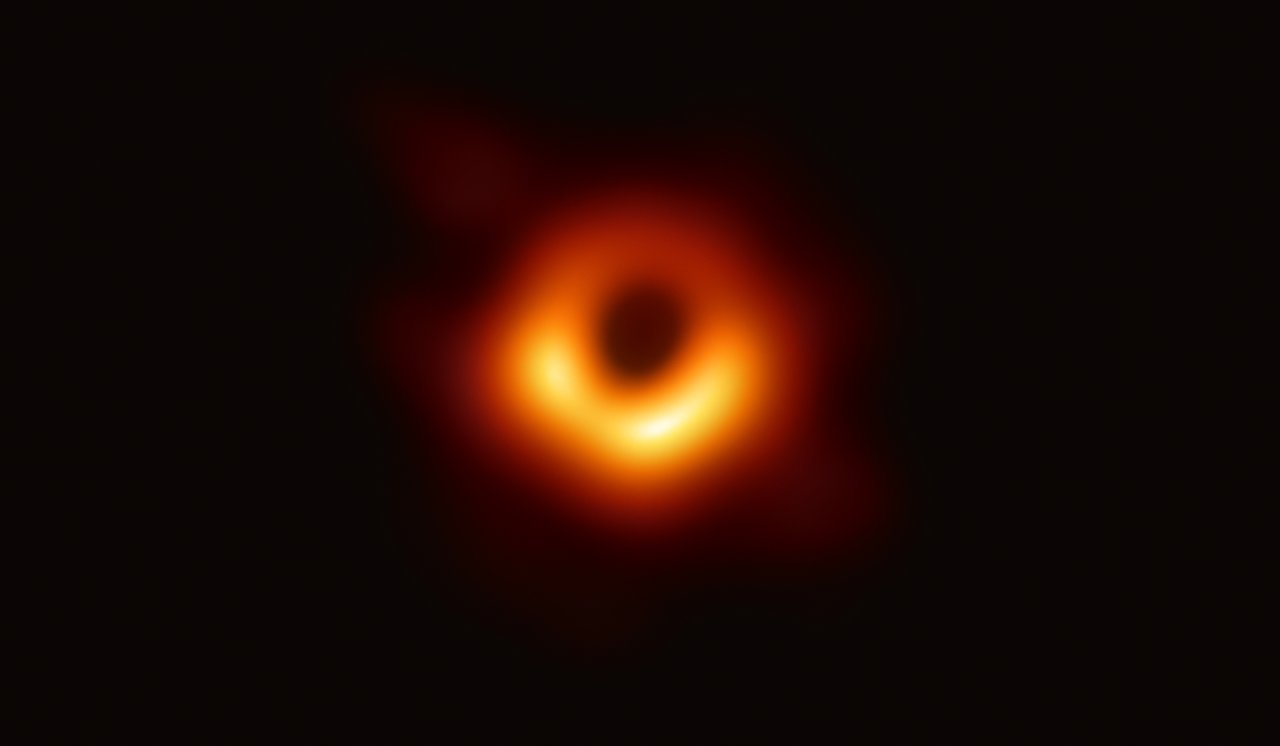
ESO: If by some chance you managed to miss this story, astronomers used a network of multiple observatories on four continents to image the supermassive black hole at the galactic core of M87:

nathanielbuildsatesseract: Space Shuttle During Atmospheric Entry (Space)

NASA: The Commercial Crew program is now targeting August for the uncrewed orbital flight test of Boeing's Starliner spacecraft. This date is partially due to congestion at Kennedy Space Center, though also gives Boeing more time to complete the parachute and pad abort tests necessary to demonstrate capsule safety.

Arianespace: OneWeb has contracted the first flight of the Ariane 6 to launch dozens of units for its satellite internet megaconstellation. Arianespace launched the company's first six satellites in February; the Ariane 6 launch is slated for late 2020.

JPL:The rotary flight demonstrated planned to fly with the Mars 2020 rover completes test hops in a simulated Martian environment. It will be the first aircraft and first helicopter to operate on another world.

JAXA: Japan successfully deploys the Small Carry-on Impactor from Hayabusa2, continuing our current international research effort of shooting-up nearby celestial objects. The spacecraft in investigate the resulting impact crater at some point in the future, but the impact was already confirmed by visual imaging:

nathanielbuildsatesseract: Space Shuttle During Atmospheric Entry (Space)

ESA: The European Space Agency will use left-over hardware from the Dawn mission for the main imagers on the Hera mission to asteroid Didymos, projected to launch in 2023. Hera will be targeting the same body as NASA's Double Asteroid Redirection Test (DART), representing the first asteroidial science collaboration.

NASA: Unexpected particle plumes erupting from Bennu and higher levels of surface debris are forcing ground controllers to modify mission plans for OSIRIS-REx. While mission planners do not believe the particles represent a serious risk to the spacecraft, the preponderance of boulders is forcing them to rethink the planned sample collection maneuver.

AIAA: Collins Aerospace and Sierra Nevada Corporation are competing to develop next-generation in-space waste-disposal systems. Most astronaut trash is currently returned to Terra in uncontrolled spacecraft; longer-term missions will need better ways to deal with the refuse of human habitation.

ESA: The X-ray Multi-Mirror Newton space telescope discovers two plumes of x-ray emitting material extending from the galactic core, providing an anticipated link between known gas clouds extending away from the galactic plane and the supermassive black hole at its center.

nathanielbuildsatesseract: Space Shuttle During Atmospheric Entry (Space)

Links post is a little short this week because my subscription to the Daily Launch expired and I haven't been checking social media as much while I study for the GRE. Here are a few stories that made it through that filter.

APOD: Solar minimum is looking exceptionally passive this time around, with zero sunspots observed in the entire month of February. There may have been sunspots not visible from Terra and interplanetary probes, but in either case, Solar Cycle 24 is coming to a rather quiet close.

SpaceX: Crew Dragon successfully completes the uncrewed Demo-1 mission, landing safely in the Atlantic Ocean after departing from the International Space Station. This sets the stage for Demo-2 this summer, carrying NASA astronauts to orbit.

CSA: Canada details a new national space strategy, renewing their commitment to robotic space exploration and international partnerships for crewed flights.

nathanielbuildsatesseract: Space Shuttle During Atmospheric Entry (Space)

Northwestern: Ground-based simulations indicate that astronauts would probably see significant performance deterioration in the cramped environment of an interplanetary spacecraft. Testing different analog habitats allows us to test existing volume requirement models.

CSA: Canada becomes NASA's first international partner on the Deep Space Lunar Orbital Platform-Gateway, pledging to contribute a robotic manipulator arm for the proposed space station. Initial press releases indicate that it will indeed be known as Canadarm 3.

JPL: Laboratory experiments aiming to replicate the environments of the early ocean depths successfully created amino acids and other organic molecules, demonstrating another path for synthesizing the biochemical building-blocks of life.

ESA: Instruments aboard Mars Express and the Mars Reconnaissance Orbiter provide evidence that ancient Martian groundwater bodies were interconnected, similar to Terra's hydrosphere.

NASA: The SpaceX Crew Dragon vehicle successfully launched to orbit and docked with the International Space Station this weekend. This is a major milestone towards Commercial Crew operations and represents the first time a spacecraft designed for humans launched from the United States since 2011.

nathanielbuildsatesseract: Space Shuttle During Atmospheric Entry (Space)

NASA: A team of planetary scientists from the SETI Institute, NASA, and UC Berkeley have a new hypothesis about the formation of a small Neptunian moon. The popular press is reporting this as a new moon discovery, but it was found in 2013 using Hubble observations from 2004 to 2009.

Virgin Galactic: SpaceShipTwo successfully completes another powered test flight, this time reaching an altitude of 89.9 km. This was also the first time the vehicle carried three crewmembers, which together with onboard experiments puts the total weight near that for commercial flight operations.

JAXA: The Hayabusa2 probe successfully touched down on the surface of Ryugu, conducting the planned sample-collection routine. That sample and others from the asteroid will return to Terra in 2020.

SpaceX: A reused Falcon 9 launched an Indonesian communications satellite, with an Israeli lunar probe as a secondary payload. The Beresheet spacecraft is the first privately-funded Luna mission, and will make Israel the fourth country to launch payloads to its surface if the April landing attempt proves successful.

ESA: New research using old data from the joint NASA/ESA SOHO spacecraft confirms that the tenuous outer reaches of the upper atmosphere extend past Luna's orbit.

NASA: The SpaceX passes the NASA Flight Readiness Review for the uncrewed Demo-1 test of the Dragon 2 spacecraft. The launch date holds at 2 March 2019.

nathanielbuildsatesseract: Space Shuttle During Atmospheric Entry (Space)

This might be an unpopular opinion, but I think that "Earth", "Sun", and "Moon" are kinda silly names for the natural bodies in the Solar System.

"Earth" I can live with, but "Moon"? That's ridiculous, there's hundreds of moons. Unless you're pointing it out in the sky, call ours Luna.

Similarly, the Sun is okay when we're talking about our Solar System or the star we can see in the daytime, but if other stars qua celestial bodies are part of the conversation we should say Sol.

It will be my official policy on this account to use "Terra", "Luna", and "Sol" whenever appropriate.

Profile

nathanielbuildsatesseract: Inverted World Satellite Map centered on Afro-Eurasia (Default)
Nathaniel

May 2024

S M T W T F S
   1 234
567891011
12131415161718
19202122232425
262728293031 

Syndicate

RSS Atom

Most Popular Tags

Style Credit

Expand Cut Tags

No cut tags
Page generated Mar. 28th, 2026 04:22 pm
Powered by Dreamwidth Studios